✈️ Careers in aviation: an exciting world between sky and earth
The aviation industry inspires dreams. It immediately brings to mind travel, cutting-edge technology, and unfailing precision. Yet behind every flight lies a multitude of professions, some highly visible, others completely unknown to the general public. From the cockpit to ground services, maintenance, and traffic management, let's take a look at the professions that keep modern aviation flying high.
Cockpit professions: pilots and co-pilots
Among the most well-known professions, that of airline pilot is often seen as a childhood dream. Their role is not limited to "flying a plane":
- Careful preparation of flight plans
- Weather monitoring
- Continuous monitoring of instruments
- Communication with the control tower
- Emergency management
The training is demanding: flight school, flight hours, certifications... but the reward is unique: having the sky as your office.
Flight attendants: flight attendants and stewards
Flight attendants ensure the safety and comfort of passengers. Their daily routine:
- Safety demonstrations
- Onboard service
- Assistance in case of incident
- Managing sensitive situations (stress, discomfort, turbulence, etc.)
Multilingual, diplomatic, and cheerful, they are the face of the airline. Their profession requires availability and the ability to adapt to irregular working hours.
Maintenance professions: guardians of safety
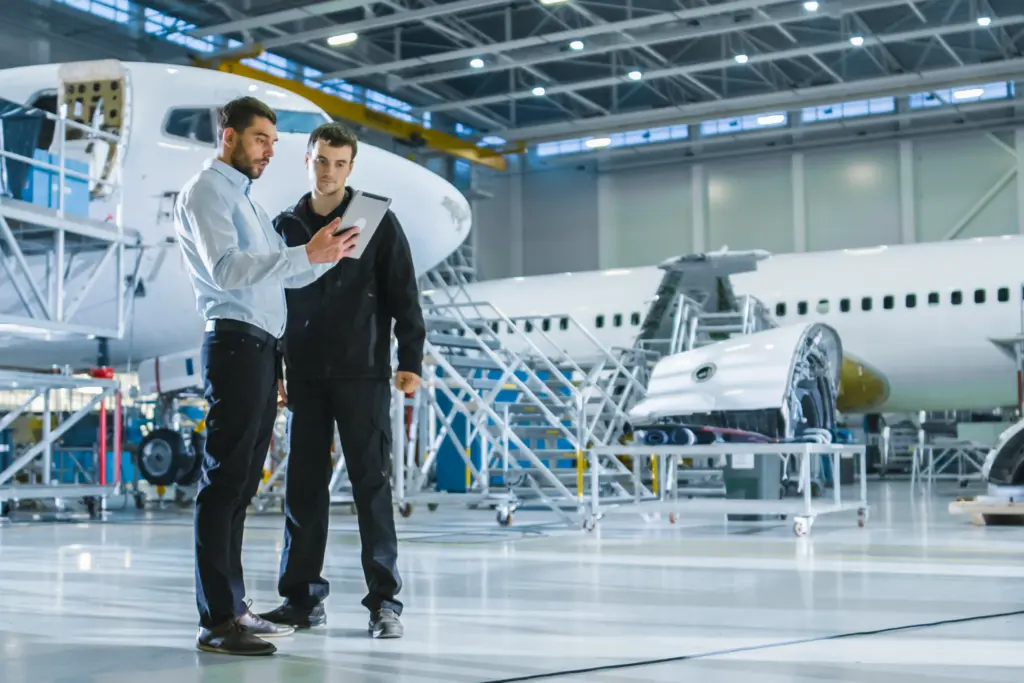
An aircraft never leaves the ground without being inspected. Aircraft maintenance technicians and engineers are responsible for:
- Technical inspections
- Repairs and replacement parts
- Updating avionics systems
- Strict security procedures
They often work at night or during stopovers to ensure that everything is ready for the next flight.
Soil-related professions: precision logistics
Before taking off, an airplane depends on an entire ground crew:
- Ground staff: Responsible for checking in passengers, managing boarding, connections, and reception. They are at the heart of the customer experience.
- Baggage handlers and ramp agents: Without them, luggage would not be loaded or unloaded. Their work is essential to ensuring that flights are on time.
- Airport vehicle drivers: Pushback tractors, catering trucks, passenger boarding bridges... these specialists operate unique machines.
The masters of the sky: air traffic controllers
Air traffic controllers monitor and coordinate air traffic to prevent collisions and keep traffic flowing smoothly in the sky.
It is a stressful, highly technical, and well-paid job that requires exceptional concentration skills.
Background roles: engineering, security, management
Less visible but just as essential:
- Aeronautical engineers (R&D, aircraft design, energy optimization)
- Aviation security specialists
- Flight analysts and planners
- Operational managers in airlines
They are the ones who guarantee the performance, safety, and development of the sector.
A constantly evolving sector: a forward-looking conclusion
The aviation industry has never stopped reinventing itself, but recent years have accelerated its transformation. Between the ecological transition, the digitization of operations, and the rise of new technologies such as artificial intelligence and drones, the aviation industry is entering a new era. The professions that make up the industry are also evolving, requiring new skills, constant adaptability, and a deep understanding of global issues.
Pilots now use increasingly automated navigation systems. Technicians must master hybrid or electric aircraft that are constantly evolving. Air traffic controllers face denser traffic, while ground crew rely on smart tools to optimize every minute of a layover. Even service- and customer-oriented professions are modernizing, with the integration of digital and personalized solutions.
But despite technology, flying remains above all a human adventure. Every flight is made possible by a chain of passionate, rigorous, and committed professionals. Each one, at their own level, contributes to ensuring the safety, comfort, and enjoyment of travel.
At a time when the sector is facing major challenges—reducing its carbon footprint, the rise of biofuels, new modes of mobility—it continues to offer rich and varied employment opportunities, open to all those who wish to take on these challenges and participate in the mobility of the future.
Ultimately, careers in aviation are not just professions: they are vocations. It is a world where dreams meet precision, where innovation serves humanity, and where, every day, thousands of women and men work together to bring the world closer together.

Président & Dirigeant Responsable | Hexagone Aviation Group | Ingénieur Génie Civil | Gouvernance et développement d’organisations