This is a historic moment for France and for the entire European scientific community: Sophie Adenot, engineer, test pilot, and astronaut withthe European Space Agency (ESA), has joined the International Space Station (ISS) as part of the Epsilon mission. She thus becomes the second French woman to fly in space, 25 years after Claudie Haigneré, and one of the leading figures in French space exploration in the 21st century.
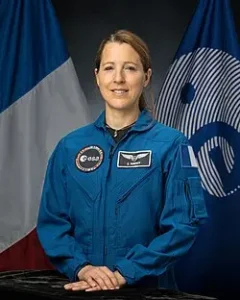
An exceptional career in aeronautics and space
Born on July 5, 1982, in Cosne-Cours-sur-Loire (Nièvre), Sophie Adenot developed a passion for space and aeronautics at an early age. Inspired by previous French missions, she built a career of excellence combining engineering, piloting, and scientific research. After earning a scientific baccalaureate and completing a preparatory class, she enrolled atISAE-SUPAERO (Toulouse), one of the most prestigious engineering schools in the field of aeronautics and space. She then pursued a master's degree at MIT, specializing in human factors related to space flight.
His professional career is exemplary:
- Engineer at theAirbus Helicopters design office, working on advanced aircraft systems.
- Helicopter pilot inthe Air and Space Force, carrying out rescue and transport missions.
- First female helicopter test pilot in France in 2018, with over 3,000 flight hours on 22 types of aircraft.
These experiences have enabled him to develop essential skills: technical mastery, management of complex systems, precision in critical situations, and rapid decision-making. These qualities are indispensable aboard the ISS, where every scientific experiment and every maneuver requires total commitment.
From pilot to astronaut: a dream come true
In November 2022, Sophie Adenot was selected as a career astronaut by the ESA from among more than 22,000 candidates. After a year of intensive basic training at the European Astronaut Center in Cologne, she obtained her official certification in April 2024. Shortly thereafter, she was assigned to her first space mission, Epsilon, a nine-month stay aboard the ISS, where she will contribute to scientific experiments and complex operations in collaboration with an international crew.
A scientific mission with multiple challenges
Sophie Adenot's mission is not merely symbolic: it is part of a major scientific program. On board the ISS, she will participate in experiments on:
- Human biology and physiology in microgravity
- Fundamental physics and materials research
- Observing and studying Earth from space
- Aerospace technologies and their future applications
Microgravity provides a unique laboratory for understanding phenomena that cannot be reproduced on Earth, with direct benefits for medicine, engineering, and even aviation.
Space and aeronautics: expertise that transcends borders
Sophie Adenot's career path perfectly illustrates the continuity between aeronautics and space. Her experience as a test pilot taught her how to manage complex systems and make quick decisions in extreme conditions. These skills, developed in the air, are directly transferable to space, where the slightest error can have immediate consequences.
At Hexagone, we see this link as a concrete example of technological and human transfer: innovations developed for space flight fuel aeronautics and piloting practices on Earth, while aviation methods and discipline enhance the safety and efficiency of space missions. The boundary between sky and space is blurring, driven by strategic vision and advanced engineering.
Thus, space is not a break from aeronautics: it is a natural extension of it, where the experience gained in the air becomes a springboard to the stars.
An inspiring figure for future generations
Beyond her technical achievements, Sophie Adenot is an inspiring role model for women in science and technology. By becoming the second French woman in space, she shows that determination, rigorous training, and passion can break down even the most ambitious barriers.
Her career path also illustrates the importance of diversity in space exploration and scientific innovation. Today, long-term missions benefit from mixed, multidisciplinary teams, enriching research and strengthening international collaboration.
A source of national and international pride
Sophie Adenot's departure for the ISS marks France's return to space after 25 years, but it is also a victory for science, aeronautics, and the inspiration of future generations. Her mission serves as a reminder that space is a unique laboratory where technology, engineering, and human collaboration come together, and that France continues to play a major role in it.
With Sophie Adenot, we follow a trajectory that links aeronautical innovation and space exploration, showing that the human and technical skills acquired on Earth can push the boundaries of the unknown, all the way to the stars.
Président & Dirigeant Responsable | Hexagone Aviation Group | Ingénieur Génie Civil | Gouvernance et développement d’organisations