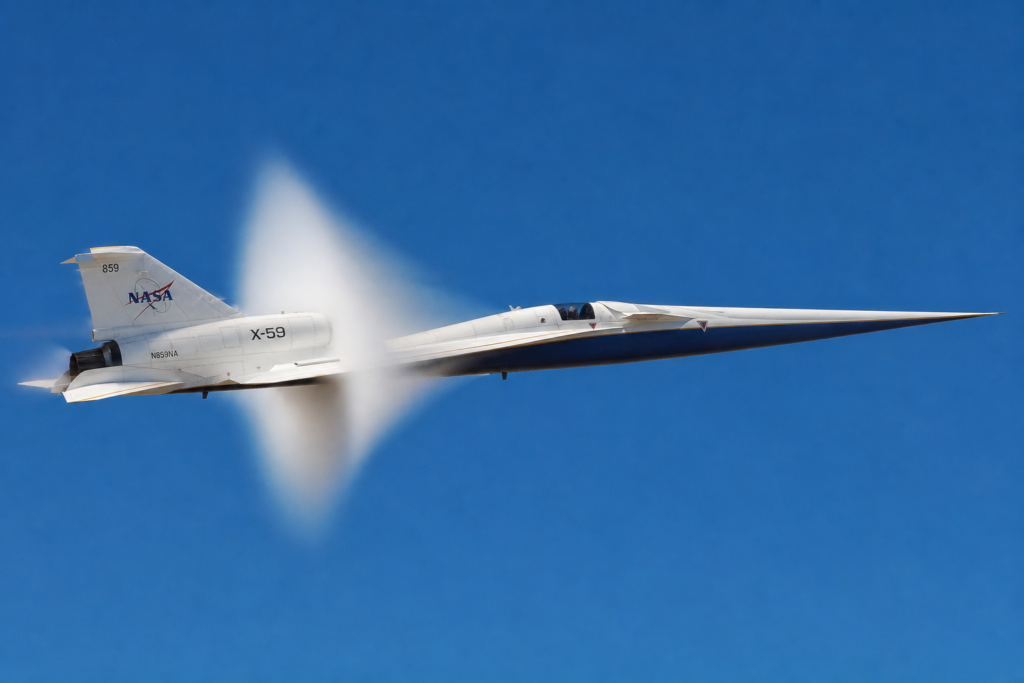
NASA has reached a historic milestone in the development of supersonic aviation with its X-59 demonstrator, designed to significantly reduce the sonic boom. This experimental aircraft has just successfully completed its first supersonic flight.
The Essentials
- The X-59 broke the sound barrier for the first time during a test flight
- This experimental device aims to reduce the sonic boom to a mere thud
- The demonstrator is being developed as part of NASA's Quesst program
- This technology could revolutionize commercial supersonic aviation
A historic break of the sound barrier
NASA’s X-59 demonstrator achieved a major technical milestone by breaking the sound barrier during a test flight. This first foray into supersonic flight marks a decisive step forward in the research program on quiet supersonic aviation. The aircraft, which features a unique aerodynamic configuration, was specifically designed to minimize the shock waves generated during supersonic flight. This test flight serves as concrete validation of the years of research and development invested in this ambitious project. NASA teams meticulously prepared for this moment, conducting numerous simulations and ground tests before authorizing this historic milestone. The aircraft demonstrated its ability to reach and maintain a speed faster than the speed of sound while maintaining optimal flight stability. This technical achievement paves the way for a new generation of supersonic aircraft intended for civil transport.
Technology for Quiet Supersonic Flight
The X-59 embodies a revolutionary approach to supersonic aircraft design. Its slender silhouette and exceptionally long nose are not merely aesthetic choices, but the result of sophisticated aerodynamic calculations aimed at fundamentally altering the nature of the shock waves produced during supersonic flight. Unlike conventional supersonic aircraft, which generate a double sonic boom that is particularly disruptive on the ground, the X-59 has been optimized to transform these shock waves into a series of less intense microwaves. The expected result is a simple thud, comparable to a distant rumble rather than the characteristic explosion of a traditional sonic boom. This innovation relies on a very specific distribution of the aircraft’s volume along its fuselage, in accordance with the principles of the area rule developed in the 1950s but pushed here to its extreme. Engineers have also integrated advanced flight control technologies to maintain stability despite this unconventional aerodynamic configuration. The ultimate goal is to reduce the intensity of the sonic boom to approximately 75 decibels as perceived on the ground—roughly the sound level of a car door closing—compared to the 105 decibels generated by current supersonic aircraft.
The Quesst Program and Its Goals
The X-59 is part of the Quesst program—an acronym for Quiet SuperSonic Technology—launched by NASA to explore the possibilities of restoring civil supersonic air travel over land. Since the ban on civil supersonic flights over land in the 1970s—primarily due to noise pollution caused by the Concorde and other experimental aircraft—commercial supersonic aviation has been confined to oceanic routes. This limitation has significantly reduced the economic viability of civil supersonic transport and hindered its development. The Quesst program aims to provide objective scientific data on human perception of attenuated sonic booms by flying over various U.S. communities once the flight certification phase is complete. These measurement campaigns will gather valuable information on public reaction to this new type of supersonic acoustic signature. The collected data will then be submitted to international regulatory authorities, including the Federal Aviation Administration and the International Civil Aviation Organization, in the hope of changing current regulations regarding civil supersonic flight. If the program succeeds in demonstrating that the noise generated by the X-59 is socially acceptable, it could pave the way for a new era of commercial aviation in which intercontinental travel would be completed in significantly less time.
Implications for the future of commercial aviation
The success of the X-59’s first supersonic flight represents much more than just a technical feat for NASA. It has the potential to serve as a catalyst for a major transformation of the commercial aviation industry. Several manufacturers and startups are already working on next-generation supersonic aircraft projects, eagerly awaiting the results of the Quest program to validate their own designs. The prospect of being able to complete transcontinental flights in half the time is generating considerable interest among both airlines and certain segments of the business and high-end travel markets. Potential applications extend beyond passenger transport and could include express cargo, emergency medical evacuations, or government flights. However, numerous challenges remain beyond the issue of noise alone. The energy efficiency of supersonic aircraft, their carbon footprint, and their economic viability in the context of the green transition are the subject of intense debate. The fuel consumption of a supersonic aircraft remains significantly higher than that of a subsonic aircraft for the same distance traveled, raising legitimate questions about the environmental sustainability of this technology. The technologies developed as part of the X-59 program could nevertheless find applications in other areas of aeronautics, contributing to the overall improvement of aircraft performance and efficiency.
Frequently Asked Questions
What is the X-59's expected top speed?
The X-59 is designed to fly at a cruising speed of Mach 1.4, or approximately 1,500 kilometers per hour at high altitude. This speed was specifically chosen as the optimal balance between supersonic performance and minimizing the sonic boom, allowing for the demonstration of noise-reduction technology while remaining within a flight envelope representative of the future commercial applications being considered.
When will the X-59 fly over populated areas to measure noise levels?
Flights over U.S. communities are planned following the full completion of the flight test program and the aircraft’s certification. NASA plans to begin these public noise measurement campaigns in the coming years, once the flight envelope has been fully explored and validated under optimal safety conditions, thereby enabling the collection of reliable data on how the public actually perceives the noise.
Will this technology be applicable to commercial aircraft?
The design principles developed for the X-59 are theoretically applicable to commercial aircraft, but their practical implementation will require significant modifications. A supersonic airliner would need to carry dozens of passengers, which implies a wider fuselage and different aerodynamic trade-offs. The lessons learned from the X-59 program will nevertheless provide a valuable scientific foundation for future manufacturers of civil supersonic aircraft, guiding their design choices.
Conclusion
The X-59’s breaking of the sound barrier marks a historic milestone in the quest for quiet, socially acceptable supersonic aviation. This technical achievement validates years of research and opens up promising prospects for the future of high-speed air travel. The next steps in the Quesst program, particularly the acoustic measurement campaigns conducted among local communities, will be decisive for the evolution of international regulations and the potential development of a new generation of supersonic commercial aircraft. NASA is thus demonstrating its pioneering role in exploring innovative aeronautical technologies capable of permanently transforming the landscape of global civil aviation.
Source: Le Journal de l’Aviation

Président & Dirigeant Responsable | Hexagone Aviation Group | Ingénieur Génie Civil | Gouvernance et développement d’organisations