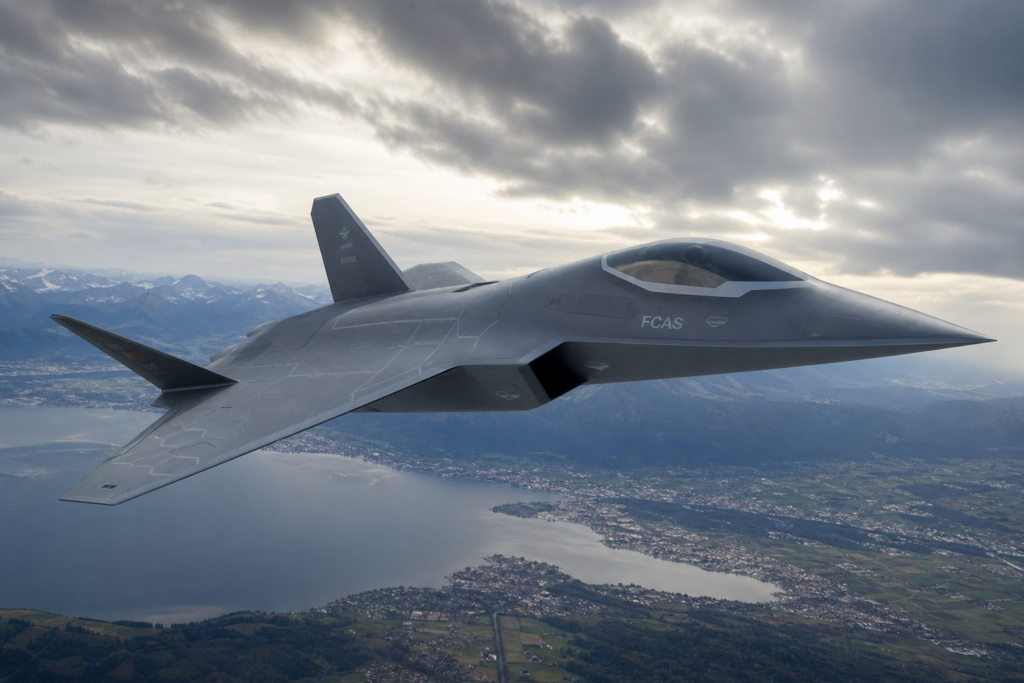
Germany and France have terminated the Future Combat Air System (FCAS) program, an ambitious sixth-generation fighter jet project, following years of fruitless negotiations among the manufacturers involved.
The Essentials
- Germany and France have officially abandoned the FCAS sixth-generation fighter program
- A persistent deadlock between Dassault Aviation, Airbus, and their partners led to this failure
- The project, launched several years ago, aimed to develop a collaborative air combat system
- This break marks a major turning point in European defense aviation cooperation
An ambitious project that failed to overcome industry-wide differences
The FCAS program was one of the most ambitious initiatives in the European defense aviation industry. Designed as an air combat system of the future, it was intended to enable France and Germany to maintain their technological sovereignty in the face of American and Asian developments in the field of next-generation fighter jets. The project was not limited to a simple fighter jet, but encompassed a complete ecosystem including combat drones, command and control systems, as well as advanced connectivity capabilities between different platforms.
The FCAS’s technical ambitions were particularly high. The program aimed to integrate cutting-edge technologies such as artificial intelligence, next-generation stealth capabilities, and energy-directed weapon systems. The goal was to create an aircraft capable of dominating the airspace for decades to come, with an expected entry into service in the 2040s. However, these ambitions ran up against complex industrial and political realities that ultimately brought the project to an end.
Tensions between Dassault Aviation and Airbus at the heart of the failure
The industrial deadlock that led to the cancellation of the FCAS stems from deep-seated disagreements among the project’s key players. Dassault Aviation, the French manufacturer with extensive experience in the Rafale and Mirage programs, and Airbus, the European aerospace giant with a strong German presence, were never able to reach agreement on fundamental aspects of the program. Issues of industrial leadership, technology sharing, and the division of labor remained intractable points of friction throughout the negotiations.
These tensions also reflected differing approaches to the design and development of military aircraft. Dassault Aviation has a long tradition of full prime contractor responsibility for its fighter programs, while Airbus favors a more collaborative and federative approach, inherited from its own multinational structure. This fundamental incompatibility in working methods and corporate cultures made cooperation increasingly difficult over time, despite diplomatic efforts by the French and German governments.
Major strategic implications for European defense
The cancellation of the FCAS program represents a significant setback for European strategic autonomy in the field of air defense. This project was considered a cornerstone of Europe’s ability to develop and produce its own high-tech weapons systems, independently of the United States or other global powers. Its failure raises important questions about the viability of major defense cooperation programs within the European Union and about the ability of European nations to overcome their national differences for projects of common interest.
This break comes at a particularly sensitive geopolitical juncture, when the need for air defense is growing. European countries will now have to reconsider their options for replacing their aging fighter fleets. Some may turn to American solutions such as the F-35, while others may explore national programs or various bilateral partnerships. France, with Dassault Aviation, has the capabilities to pursue a national program, but Germany finds itself in a more delicate position, having historically relied on international cooperation for its major military equipment.
The economic and industrial consequences of the abandoned project
Beyond the military and strategic aspects, the failure of the FCAS has substantial economic consequences. Considerable investments were made in the preliminary phases of the program, including design studies, the development of key technologies, and the establishment of cooperative structures between industry and research institutions. These expenditures, financed in part by French and German taxpayers, will not yield the expected returns in terms of operational capabilities or economic benefits.
The European defense aerospace industry is also taking a serious hit in terms of international competitiveness. The FCAS was intended to help maintain and develop critical capabilities in cutting-edge technological fields, while offering export opportunities in the global military equipment market. Its cancellation risks weakening the position of European players vis-à-vis their American, Russian, or Chinese competitors, who are actively pursuing their own next-generation fighter programs. The highly skilled jobs and industrial capabilities associated with the project will have to be redirected toward other programs, with the risk of dispersing the accumulated expertise.
Frequently Asked Questions
What were the planned specifications for the FCAS fighter?
The FCAS was intended to be a sixth-generation air combat system featuring a lead fighter supported by collaborative combat drones. It was to incorporate advanced technologies such as artificial intelligence, enhanced stealth capabilities, and directed-energy weapon systems, with entry into service planned for the 2040s.
Why did the FCAS program fail?
The program failed primarily due to a persistent deadlock among the manufacturers involved, notably Dassault Aviation and Airbus. The disagreements centered on industrial leadership, technology sharing, and the division of labor, reflecting incompatible approaches to the design and development of military aircraft.
What are the options for France and Germany following this failure?
France has the capacity to develop a national fighter program with Dassault Aviation. Germany could turn to American solutions such as the F-35, explore other bilateral European partnerships, or participate in new collaborative projects with other partners. Both countries will need to reconsider their strategies for replacing their current fighter fleets.
Conclusion
Germany and France’s decision to abandon the FCAS program marks the end of a project that embodied Europe’s ambitions for technological sovereignty and defense. This failure, resulting from an insurmountable industrial impasse among the key players, highlights the challenges inherent in major European military cooperation programs. Beyond the immediate consequences for the defense capabilities of both countries, this breakdown raises fundamental questions about the future of European industrial cooperation and the continent’s ability to develop autonomous solutions in the face of major global powers. The lessons learned from this failure must inform future deliberations on the modalities of defense cooperation, in order to prevent industrial differences from once again jeopardizing projects of common strategic interest.
Source: AeroTime

Président & Dirigeant Responsable | Hexagone Aviation Group | Ingénieur Génie Civil | Gouvernance et développement d’organisations